
Bait and switch
The promise of success lures us down paths we wouldn't otherwise choose. So when the rewards don't materialise, what choice do we have but to quietly quit?

My 85 year old neighbour worked at four different factories in Norwich through the 60s. She walked out of one job when her manager refused to let her leave early, even though she’d finished her tasks, to be home for her kids.
‘My friend popped round and said: ‘They’re looking for someone over at Start Rite.
So I got on my bike, went over there to speak to them, and started work on Monday.’
This was the world of 1960s Britain, at least for people like my neighbour. Don’t like your job? Walk out, and then walk into another one a week later.
The expectation of work and reward, of leaving if you’re being treated unfairly and of plentiful choice of employment are relics of a bygone area. And yet, the myths from the last century still dictate our current choice of jobs or education.
But the evidence is finally mounting to prove the effort may not be worth the reward. Maybe our options are dwindling, and we have no other option but to quietly quit.
Get on yer bike
I’d never heard the phrase ‘get on your bike’ until I came to the UK. It was first framed as an admonishment to lazy workers: don’t complain about not being able to find a job. Get on your bike, and go find one.
But until last week, I’d never heard someone use it in first person. Even more, she spoke with pride and aplomb: getting a job was easy. There would always be another one if you didn’t like the one you had.
In 1960, eight million pairs of shoes were made in Norwich. Shoe making was the largest employment sector; at their peak, Norwich shoe factories employed 12,000 people in the city. Manufacturing industries, making everything from chocolate to agricultural equipment, accounted for 40% of the workforce’s employment.

I was struck by the contrast between my neighbour’s reminiscence of 1960s Norwich and today’s precarious employment and housing. Yet we still use the same catchphrases to blame the un- or underemployed, those living with parents or spending over 80% of their paycheques on debt and rent.
1965 versus 2025:
Unemployment rate
Today, it’s more than tripled:
from 1.2% in 1965 to 4.7% in 2025.
Average UK house price
1965: you could buy a house for £3,353 on average. Now it’s £271,809.
Average UK salary
Sure, but we make more now, right? Yes, that’s true: In 1965, the average salary in the UK was £798 per year, and now it’s £34,900.
Average ratio of house price to salary
But that means in 1965, a house was worth 4.2 times as much as you made in a year. Now, you’re paying 7.8 times your annual salary.
People in the 1960s were less likely to own their home. In 1965, just over half of homes in England were owner-occupied, and 29% were rented in the social sector. That meant more people lived in secure housing provided by the government, paying their rent to the local council.
With secure housing, low employment rate and affordable rent, if you wanted a job, you could get one easily. All you had to do was get on your bike.
Who Moved My Cheese?
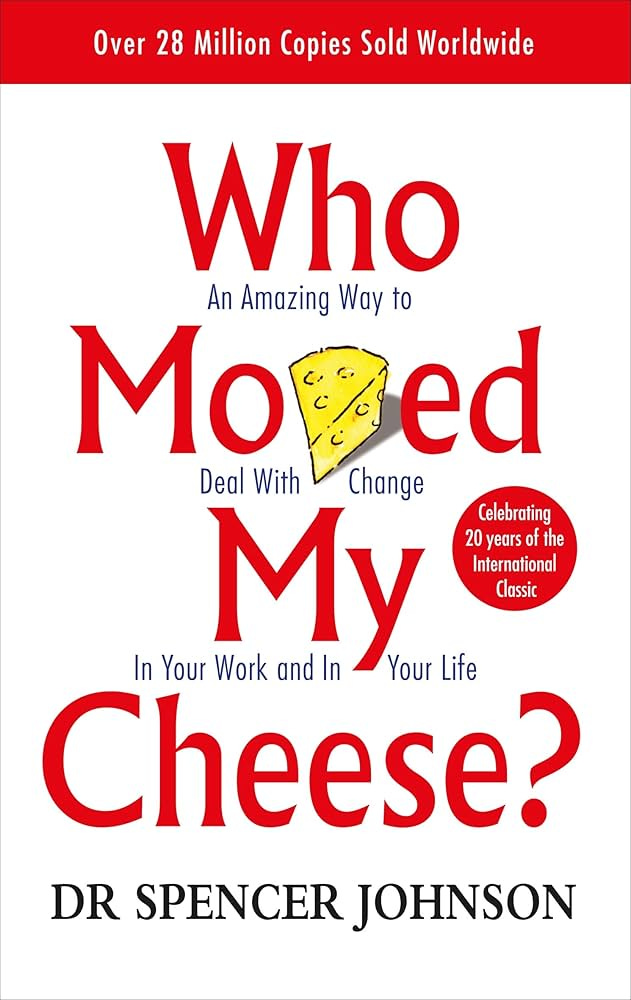
In 1998, Spencer Johnson wrote the motivational business story of Who Moved My Cheese. Recommended to me over the years by people as diverse as my therapist, my boss and my father, I’d been handed the 96-page book and encouraged to welcome change as the key to personal growth, satisfaction and success.
Rather than turning up in the same place and expecting to be provided for, strike out in a new direction. Don’t ask ‘who moved the cheese’. Go find a new slice.
I’ve written about my meritocratic upbringing before (in Anything is Not Everything and Non Gradus Cum Laude). Work is intrinsically linked to worth. You can get whatever you want if you work hard enough. You don’t get handed anything, but if you put in the effort you’ll be rewarded. Effort includes: turning up early and staying late; going the extra mile; and moving cities (or countries) in pursuit of gainful employment, and eventually, of reaching higher rungs on the career ladder.
My grandmother worked in a factory. My grandfather was an agricultural labourer. My parents went to university and entered the professional workforce. As their daughter, I enacted my responsibility as a member of society by getting my first job at fifteen, with the expectation that I would attend university and make more at each subsequent job than the one before it. All I needed to do was get an education and then a job in either business or the public sector. A proven formula, predicated on the individual success myth perpetuated in North American culture: ‘if I can do it, anyone can’.
Not only can anyone do it, but everyone should. Essential to the meritocratic myth is if one makes the effort to succeed and doesn’t, it’s the fault of that individual. You can never argue that the maze is rigged, or that there isn’t enough cheese, or that there is enough cheese but it’s being hoarded by an ever-shrinking group of people at the top of the corporate food chain. That’s no way to keep everyone running the maze. Instead, you need to keep each person focused on their personal gain so they can’t turn their attention to anything beyond their own survival and success. Therefore, it must be reinforced that:
Failure isn’t a systemic issue. It’s an individual one.
Bait and Switch
This hyper-focus on individual success forms the basis of Barbara Ehrenreich’s 2005 exposé of ‘the futile pursuit of the corporate dream’. An investigative journalist, she spent ten months with middle-class executives ‘in transition’—the common euphemism for ‘out of work’ or ‘unemployed’. Previously only interested in reporting on poverty in blue-collar entry-level work, characterised by low pay and precarious contracts, Ehrenreich became interested in stories of white-collar downward mobility because they
‘…cannot be brushed off as easily as accounts of blue-collar economic woes, which the hard-hearted traditionally blame on ‘bad choices’; failing to get a college degree, for example, failing to postpone child-bearing until acquiring a nest egg, or failing to choose affluent parents in the first place.
But distressed white-collar people cannot be accused of fecklessness of any kind; they are the ones who ‘did everything right’. They earned higher degrees, often setting aside their youthful passion for philosophy or music to suffer through dull practical majors like management or finance. In some cases, they were high achievers who ran into trouble precisely because they had risen far enough in the company for their salaries to look like a tempting cost cut.
They were the losers, in other words, in a classic game of bait and switch.’

‘Bait and switch’ refers to advertising goods at an apparent bargain price, and then swapping them for an inferior product once the purchase has been made. You make an investment, in money or time, but you don’t receive the promised reward. It may be thousands of pounds or dollars for a degree you then spend your life repaying. Or the years of boredom, in an internship or entry-level role in accounting, that don’t result in a partnership or role in the C-Suite.
When Ehrenreich started her project in 2003, unemployment sat at 5.9%, with almost 20% of the unemployed workforce made up of qualified professionals. Throughout her investigation, she interviews, consults and fraternises with professional coaches, networkers, HR hirers and hundreds of fellow un- or under-employed workers who define themselves as ‘in transition’. She never receives a job offer. Most of the people she meets along the way don’t, either.
I feel edified and relieved in the reading. I take solace in knowing that, even if I’d finished my degree and scored the corporate entry-level job, that I may find myself, decades on, made redundant or languishing in middle-management, disinterested and disillusioned.
My generation (I’m an old millennial) benefitted from a prosperous and fairly stable upbringing and a fairly straightforward entry into the world of work. I’m one of the privileged who has only ever been unemployed by choice, leaving jobs to go travelling or attend long meditation retreats, and spending only few weeks or months finding new ones, with the benefit of savings and spousal support to see me through. The problem with people like me is: it’s easy to universalise our experience. This is what we did and how we had it, and this is what you do to get what we’ve got: ‘if I can do it, so you can you.’
Quietly quitting
While Generation X and the Millennials are dealing with the falsity of the progress myth, our younger counterparts, Gen Z, are contending with a new brand of disappointment. Even if they make the same level of effort, in hours of work and pennies saved, as the previous generation, they will get half the reward—or less. It’s not that they don’t want to work hard: it’s that working that hard doesn’t get them what it used to. It’s harder to justify.
I’ve heard two definitions of quietly quitting:
Doing the bare minimum at your job. Instead of organising your team’s away day or staying late on a Friday, you jiggle your mouse to make it look like you’re busy, make deadlines but don’t take initiative and essentially avoid the above and beyond.
Going down to part-time or a lower-paid job to prioritise your wellbeing and spending more time and energy on what makes you happy. Gabrielle Judge, known online as Anti Work Girlboss, coined the term ‘lazy girl job’ for work that is low in stress but pays enough to cover the essentials.
Judge explains what’s changed:
‘There is a tendency online to blame all societal ills on our parents’ generations … but baby boomers aren’t stupid for doing what they did for their careers … I’m just saying it doesn’t work in today’s age. The return on investment on working all hours for some kind of meritocratic ideal just isn’t the same any more.’
- Gabrielle Judge in ‘The Soft Life’, The Guardian April 2024

My version of quietly quitting came a decade and a half earlier, when I left my job in corporate Calgary in early 2008, narrowly missing the financial crash that would come a few weeks later. I decided office life wasn’t for me, and spent the next decade working in low-paying roles in hospitality and part-time at a local charity before training as a yoga teacher; I was ahead of the curve in living the soft life.
But it’s becoming the norm for young adults to make these decisions at twenty-two, not twenty-eight. What took me a decade of disillusionment to figure out, they’re understanding much earlier.
Hard sell
From getting on your bike, to sniffing out the new wedge of cheese, to taking the bait, each decade has a different metaphor of individual success for sale. But with mounting evidence of systemic stagnation, unaffordable housing and declining social mobility, each new iteration becomes a harder sell.
These metaphors don’t elucidate a hidden truth. They obscure it. Because individual success isn’t determined solely by effort and skill. Increasingly, it’s a lottery. It’s not about the individual doing more. It’s about the system failing all of us. Ehrenreich says:
From the point of view of the economic ‘winners’—those who occupy powerful and high-paying jobs—the view that one’s fate depends entirely on oneself must be remarkably convenient. It explains the winners’ success in the most flattering terms while invalidating the complaints of the losers.
Those who blame their predicament on the economy, or the real estate market, or the inhuman corporate demands on their time, found these culprits were similarly dismissed in favour of alleged individual failings: depression, hesitation, lack of focus.
It’s not the world that needs changing, is the message, it’s you. No need, then, to band together to work for a saner economy or a more human-friendly corporate environment, or to band together at all. We are our own enemies.
When I place myself alongside those with successful careers, high-paying jobs and exotic vacations, I am one of the losers. I have no six-figure salary to show for my efforts. I’ve spent somewhere between two-and-a-half to three years of my adult life out of work, either travelling or on retreat. My jobs have rarely required a commute, so my free time has always been my own. I keep my weekends and evenings relatively spacious, spending a lot of time sitting still and visiting with friends. I don’t have any car payments, my mortgage is low and I’m not trying to max out my ISA.
But by disagreeing with the base premise of winners and losers, I undermine the argument on its own terms. I refuse to make enemies, either with job seekers, quiet quitters or even those who have elected to live the corporate life. Instead, I want to band together with others challenging individual blame and seeking systemic change: dispersing company profits more equally, protecting entry-level workers and creating mutual commitment between corporations and government to care for citizens: employed or not.
Until then, though, I’ve made the only sane choice available to me. I surveyed my options, observed the direction of travel, and made the most rational decision: I gave up the bike, the cheese and the bait, and chosen a quiet, soft life.
Fellow soft life early adopter here 🙌 Living to enjoy the current phase of life has always been my default…intentionally or not. There’s a LOT of privilege of various kinds that has made that possible for me (as you touched on). I still worry / kind of expect that the bill will come due someday
I read recently that 100k is the equivalent to a 40k salary 20 years ago now due to inflation. My sister was saying the salary she was on and had aimed for she felt would be great for saving and having holidays but it somehow still feels like a struggle. Effort for outcome not stacking up - yet the promise it would. The conditions of the world have changed so much but the rhetoric hasn’t like you say. I have no idea how very low wage workers can afford to live right now and I worry for my daughter’s generation. That’s without ai and robotics changing the landscape of the world completely - predictions saying we may enter a dystopia for 15 years as that happens. I really hope not!